Your client reports are already being read by machines. Can they be understood?

RMs, clients and compliance already read reports through AI tools. Reporting Maestro captures structure, context and provenance at source, so those systems cite the report instead of guessing.
Structure at source: headings, table semantics, chart series, period and currency are known when the report is built, not reconstructed by OCR afterwards.
One structural investment, two mandates: the structure machine readability needs is what accessibility standards (EN 301 549, PDF/UA) already demand.
Compatible with Avaloq, Temenos Wealth Suite, Finnova, Olympic, T24 and all major core banking systems, without a full IT project.
Hero-background

Financial institutions that rely on Reporting Maestro for compliant client communication

Download the Guide Directly Here

Download Guide

What happens when AI reads your client PDFs

 Independent benchmarks, not vendor claims.
81
%
of financial questions wrong or refused when AI reads PDF filings
91%
accuracy when the answer sits in one place
4
4%
accuracy when it spans more than one report

Three roles for AI across the reporting lifecycle

Each is a separate capability with its own controls. Most programmes currently use only the first.

Write. First drafts in minutes, every sentence grounded

 Not a general chatbot writing the report, but a controlled first draft from approved data, rules and context: performance commentary, table-to-insight, chart-to-narrative, multilingual output in English, French, German and Italian. Every sentence stays traceable to an approved data snapshot, a defined rule set and a recorded reviewer decision. A named reviewer accepts, edits or rejects, so human attention shifts from repetitive drafting to judgement and exceptions.

Check. Find costly errors before the client does

For many institutions the most credible first use of AI is not generation but assurance. Deterministic rules stay authoritative for calculations, mandatory fields and thresholds. AI handles what sits between them: a sentence that contradicts a table, a benchmark named but not displayed, a missing currency, an unexplained chart, a tone that crosses from reporting into recommendation. The result is an evidence-backed issue list with severity, location and source facts, not an opaque quality score.

Read. Cited answers from every published report

Once released, the PDF enters the client portal, the RM workspace, the archive and the compliance case file. AI can prepare a client-call briefing, compare periods or retrieve an explanation given during a past market event. A reliable answer must know which client and portfolio the document concerns, the period and currency, the meaning of each table and the scope of each disclaimer. It must also respect the bank's entitlement model, because machine readability never replaces access control.

How Reporting Maestro builds machine readability into every production cycle
Three components covering the full client reporting chain, from core banking data to governed, distributed documents. Built from 10+ years of reporting practice with financial institutions across Europe.

Automated Production

Reporting Maestro: the governed production engine
Reporting Maestro consolidates data from Avaloq, Triple'A, Finnova, Olympic and T24, produces branded documents at scale and manages controls, review, distribution and archiving in one governed process. Every manual assembly step outside that chain is a point where semantic structure is lost. The platform is the control plane into which governed AI services are inserted, not a replacement for them.

Multi-Channel Distribution

One production run. Every channel. Every format.
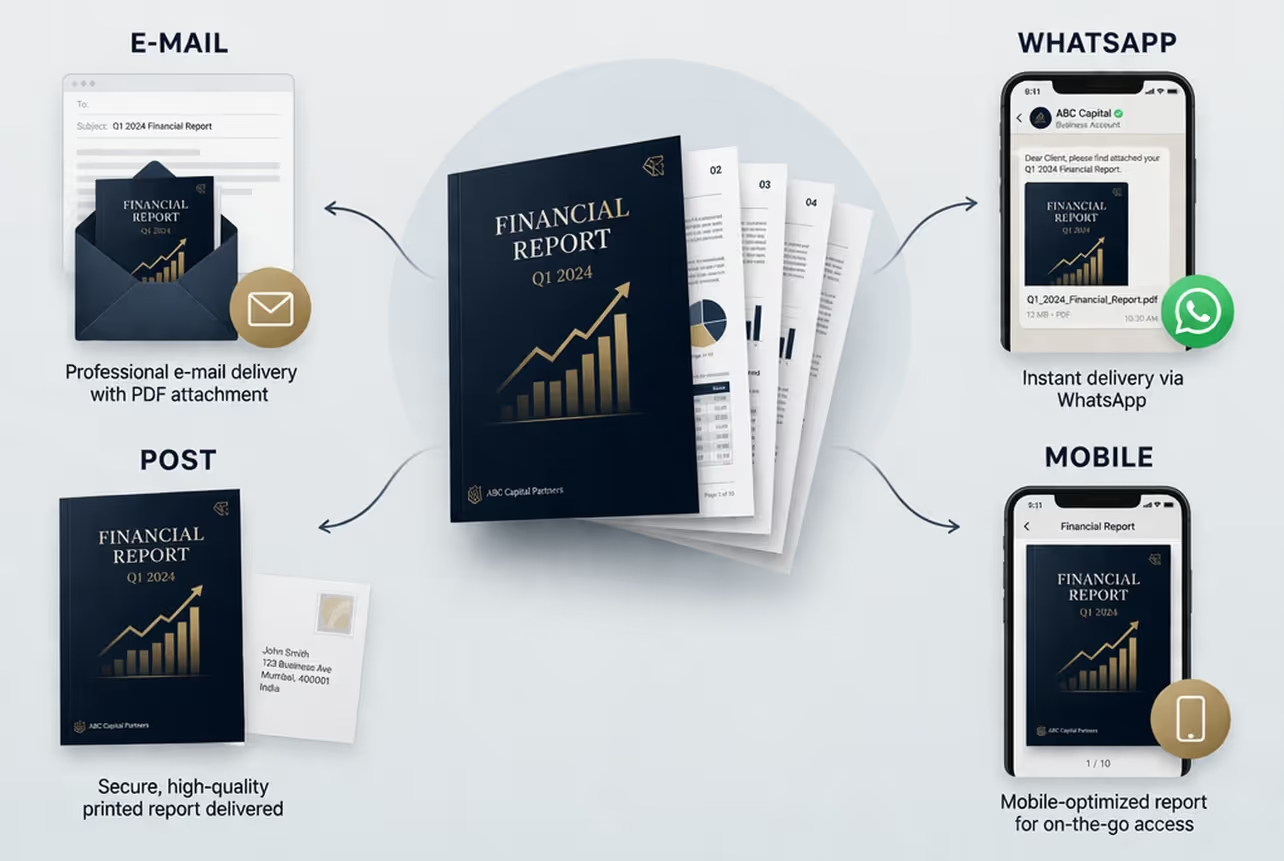
Accessibility applies to every channel a client receives a document through: e-banking portal, email, WhatsApp, print and mobile. Reporting Maestro distributes the same report to all channels in one run, applying format-specific accessibility requirements per channel. The structured PDF output carries tagged content, defined reading order and identified tables for screen readers, validated against EN 301 549 with PDF/UA per run.

Business Report Designer

Your team creates compliant, structured layouts, without IT
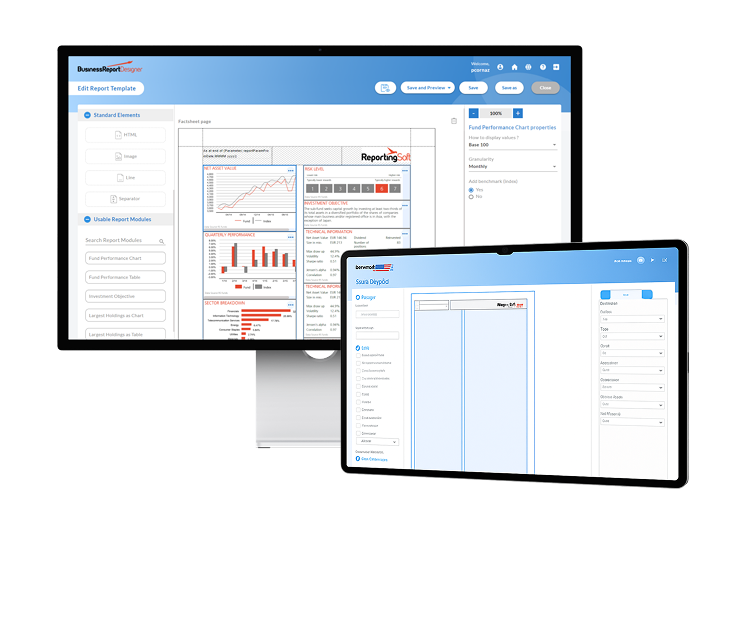
 Business Report Designer is the self-service layer on top of Reporting Maestro. Business users choose a layout from a template library, drag in report items (charts, performance tables, allocation breakdowns) and customise output in three steps. Structural requirements are enforced by the template by default, so the semantic quality of every report does not depend on the person who assembled it. The template is handed over to the production workflow for the next scheduled run, without a separate IT development cycle.

What a first governed AI pilot looks like in practice

Private bank, quarterly discretionary mandates


Starting point: Commentary for several hundred mandates is drafted and reviewed manually each quarter. Deterministic controls confirm that totals reconcile and sections are present, but nothing catches a sentence that contradicts a table or names a benchmark that is not displayed.
Solution: The AI checker runs in shadow operation against one report family, alongside the existing process, before any output reaches a client document. Reviewers receive an evidence-backed issue list with severity, location and source facts.
Result: Defects are found before release rather than by the client, and the estate's structural weaknesses are mapped before any commentary is generated.

Asset manager, RM briefings from published reports

Starting point: Relationship managers upload client reports into assistants before meetings. Answers are plausible but unverifiable, because the PDF carries no table semantics, no period context and no stable identifiers.
Solution: Reports are generated with structure at source: navigable headings, table relationships, chart context and metadata that travels with the file. Entitlements are applied before retrieval, not after.
Result: Authorised assistants cite the exact report section behind an answer instead of guessing, within the bank's existing access model.

 From pilot to production in four controlled phases

The best pilot is narrow enough to control, but real enough to expose data, workflow and review constraints. Pilot one report family, not the entire reporting estate.

1. AI Reporting Readiness Review

We review your current reporting process: which report families are produced, which core systems feed them, and where structure, controls and evidence are not yet in place for governed AI. You receive a clear picture based on your actual workflow, and a scope proposal for one report family with stable source data, meaningful narrative effort and a named business owner.

2. Data sourcing

We map Reporting Maestro to your core banking system, whether Avaloq, Temenos Wealth Suite, Finnova, Olympic, T24 or another platform. Data sources, report types, languages and distribution channels are defined. A historical validation set of previously approved reports is assembled to test extraction, checks, expected commentary and edge cases.

3. Shadow operation

Report templates are built with Business Report Designer using your branding and content modules. Every template is validated against WCAG 2.1 AA before entering production. You review and approve in the designer interface, without an IT development cycle. 

4. Go-Live and Ongoing Governance

 Production moves forward only when quality thresholds, reviewer ownership, monitoring, incident handling and the evidence package are agreed. Prompts, rules, data contracts, evaluation cases and evidence are managed outside any proprietary model interface, so you can change model, deployment option or provider without redesigning the reporting process.

What Our Customers Say

SaaS and OEM teams save time and remain compliant.
We are very satisfied with our collaboration with ReportingSoft and particularly impressed that the relationship can be so effective and straightforward despite the distance.
Daniel B.
Large out-of-home advertising company

The consultants at ReportingSoft SA are professional, competent and friendly. I have a very good relationship with the project teams.
Jean-Daniel L.
Large private bank in Geneva
We have been using the consulting services of ReportingSoft SA for over 3 years and are very satisfied. It's a true partnership.
Philippe D.
Large bank in Luxembourg
Our reports are consistently maintained and improved with 100% quality. ReportingSoft works with the precision and reliability that is essential for us, as reporting is our core business.
Lionel D.
IT system integrator, private bank in Geneva

The questions we hear from every compliance, risk and back-office team

 No. Reporting Maestro is a governed reporting platform: it prepares data, renders templates, applies controls, manages review and distribution, and holds the system of record. AI can propose, compare and explain within that process. Where controlled commentary is used, the output is a first draft that a named reviewer accepts, edits or rejects, with the evidence visible alongside it. No client-ready text is released without a recorded human decision.

A PDF generated with enough semantic structure, context, provenance and access control for an authorised system to extract and cite its content with materially less ambiguity: navigable structure, data carrying periods and units, grounded narrative, chart alternatives, citable sections and metadata that travels with the file. AI-readable PDF is a ReportingSoft working concept, not an ISO certification. PDF 2.0 (ISO 32000-2), PDF/UA-2 (ISO 14289-2) and Tagged PDF are the formal standards, and institutions should continue to test against the ones that apply to their documents.

 OCR recovers visible characters from a page. It cannot reliably reconstruct the business meaning that was lost when the document was created. It may identify "3.4%" and "MSCI World" without knowing whether 3.4% is portfolio return, benchmark return, contribution, volatility or a footnote threshold. It may not distinguish the current quarter from since-inception results and may recognise a disclaimer without understanding which section it qualifies. The reliable approach is to preserve the meaning while the report is being assembled, since the reporting engine already knows it.

The structural work is the same work. Correct reading order, proper heading hierarchy, real table semantics and alternative text for charts are what accessibility standards require and what machine readability depends on. Institutions in scope of the European Accessibility Act for consumer banking services have a legal driver for that structure. For private banking and institutional mandates the driver is different: retrieval quality, audit evidence and client experience. Accessibility standards alone do not supply the business semantics that client reporting needs, but they are the right foundation.

FINMA Guidance 08/2024 sets out a technology-neutral, proportionate approach to AI risk, covering governance, inventory and risk classification, data quality, testing and monitoring, documentation, explainability and independent review. The NIST Generative AI Profile frames governance, provenance, pre-deployment testing and incident handling as core risk-management activities. Both translate into concrete reporting controls: sentence-level grounding, defined no-generation topics, versioned prompts and rules, regression testing, and an evidence trail linking every statement to the data snapshot and human decision behind it.

 Entitlements are applied before retrieval, not after. An assistant that retrieves another client's report or a restricted annex is an access-control failure, not a model error, so permissions are enforced before the model sees any content. Uploaded document text is treated as data rather than as instructions, so hostile content cannot manipulate a downstream assistant. Approved deployment, data minimisation, encryption, defined retention terms and logging apply as standing conditions.

 No. Prompts, rules, data contracts, evaluation cases and evidence are managed outside any proprietary model interface. You can change model, deployment option or provider without redesigning the reporting process. This limits third-party concentration risk and allows different tasks to be routed to different models under one consistent control framework.

The next standard for client reports is controlled, not autonomous.

The winning model is not "AI creates the report". It is a governed reporting system in which AI accelerates selected tasks while the bank retains evidence, judgement and control. Book a 30-minute AI Reporting Readiness Review with Patrick Cornaz to see where your report families stand today.